Executive Summary
Ready for first commercial sale
Approval is the milestone every company plans toward. First commercial sale is the one that tests whether the company was built to operate. Within weeks of clearing the FDA, a manufacturer becomes a reporting entity with obligations on fixed calendars: gross-to-net reserves booked against the first shipment, an average manufacturer price and a best price due 30 days after the first quarter, serialized data moving with every shipment, and chargebacks returning from wholesalers within weeks. For a cell or gene therapy, a single manufactured batch is tied to one patient, and payment can depend on outcomes tracked for years. Commercial and medical teams get most of the pre-launch attention. The financial and operational systems beneath them decide whether the numbers hold. This paper sets out what has to be in place before first sale across pharma, biologics, and cell and gene therapy, and where the architecture tends to break. The perspective is Archer's, drawn from implementing these systems for life sciences companies moving from research into commercial operations.
The Gap Between Approval and Operating
A launch has two audiences. One is external and gets rehearsed for months: prescribers, payers, patients, and the sales force in the field on day 1. The other is internal and rarely gets rehearsed at all, the set of systems that turn a commercial sale into a number the company can report and defend.
The moment a product ships for revenue, the company changes category. It stops being a research organization that spends money and becomes a commercial entity that has to account for what it sells, to whom, at what net price, and under which government program. Most of that machinery is invisible from outside finance and operations, and the obligations do not wait for the systems to catch up.
In our implementations the pattern is consistent. The clinical and commercial launch goes well. The problems surface 60 to 90 days later, in finance. A gross-to-net accrual has to be restated because the deduction assumptions were closer to guesses than estimates. A first government pricing submission misclassifies the product. Wholesaler chargebacks do not reconcile against contract prices. Third-party logistics data does not tie to the general ledger. By the time any of this surfaces, the product is in the market and the correction happens in front of auditors.
Approval turns a company into a reporting entity overnight. The systems that make its numbers defensible are usually the last ones built.
The cause is structural. Launch readiness sits with commercial and regulatory, measured in field readiness and label. The financial and operational platform sits with finance and IT, and it is often the last thing built and the first thing overwhelmed. A company can execute the visible launch well and still spend its first 4 quarters explaining restatements.
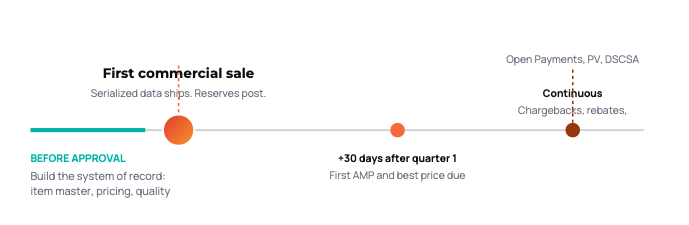
The sections that follow move through that operating layer in the order the obligations arrive: product identity, the trade channel and its serialization rules, government pricing, gross-to-net and revenue recognition, and the transparency and quality reporting that runs from launch onward. The last two sections look at where the 3 modalities diverge, most sharply for cell and gene therapy, and at what a shared platform is worth.
Product Identity and the Regulatory Record
Before a single unit ships, the product needs an identity that downstream systems can rely on. That identity centers on the National Drug Code, assigned per product and per package configuration, registered with the FDA through establishment registration and drug listing, and then referenced almost everywhere: wholesaler purchase orders, chargeback claims, government pricing submissions, serialization records, pharmacy claims, and the general ledger.
A single finished product usually carries several package configurations. Each one has its own National Drug Code, maps to a GS1 identifier for serialization, and is tracked by lot and expiry. When the item master reflects that structure accurately, downstream systems have something stable to reference. When it does not, the errors move into pricing, claims, and reporting, and they are expensive to unwind once product is in the market.
The FDA has signaled a move to a longer NDC format as the current numbering space runs low. Manufacturers that hard-coded field lengths into pricing, claims, and serialization systems face a data-join problem that is easy to underestimate. For a launching company the practical step is narrow: build the identifier structure to be reference-driven rather than assumed.
Identity is only the start of a regulatory record that does not pause at approval. A New Drug Application or Biologics License Application usually carries postmarketing requirements and commitments, and many products launch under a Risk Evaluation and Mitigation Strategy that constrains distribution and requires documented controls. Pharmacovigilance becomes a standing obligation from first sale: individual case safety reports, periodic safety reports, and signal management, each tied to quality and, increasingly, to the commercial systems that capture complaints. The question we raise early in a life sciences implementation is whether quality events, deviations, and complaints share the same platform as the product and the transaction, or sit in a separate tool that someone reconciles by hand.
Trade, Distribution, and Serialization
Most launching manufacturers do not run their own warehouse. They contract a third-party logistics provider that stores the product, ships against orders, and often runs order-to-cash on the manufacturer's behalf: invoicing, accounts receivable, chargeback processing, and returns. Under the DSCSA, third-party logistics providers are federally licensed, and a virtual manufacturer can frequently distribute under the provider's licenses, which shortens a slow, state-by-state process. In our experience the 3PL decision comes early, because it shapes both licensing strategy and the data flow that follows.
The channel above the 3PL is layered. National wholesalers move the bulk of retail and clinic volume. Specialty distributors and specialty pharmacies handle products that need cold chain, patient support, or limited distribution, which covers most biologics and most high-cost specialty launches. The choice between an open channel and a limited network affects how chargebacks flow and how much visibility the manufacturer has into where product actually goes.
Serialization is no longer a future project
The enhanced requirements of the Drug Supply Chain Security Act are now in force for manufacturers, repackagers, wholesale distributors, and larger dispensers. Small dispensers hold an exemption that the FDA has extended to November 27, 2027. In practice, each saleable unit carries a 2-dimensional GS1 DataMatrix that encodes the product identifier, lot, expiry, and a unique serial number, and transaction data moves electronically between trading partners in the EPCIS standard at each handoff. A correct barcode is not sufficient on its own. A unit can be refused at wholesaler receiving if the electronic transaction data does not arrive with it.
The return trip matters as much as the outbound shipment. A 3PL and the wholesalers send data back continuously: shipment confirmations, inventory on hand, sales-out reports, chargeback claims, credit memos, and cash receipts. When that data does not load cleanly into the manufacturer's ERP, inventory, accounts receivable, and revenue drift from reality, and the gap tends to show up first in a failed reconciliation. An integration that pulls 3PL transactions into the ledger on a schedule, generates the matching records, and flags exceptions is what lets a finance team review exceptions rather than rekey files.
Government Pricing and Market Access
Selling into the programs that cover most American patients means enrolling in them, and enrollment carries obligations that begin immediately. The Medicaid Drug Rebate Program requires a National Drug Rebate Agreement with CMS, which is effectively a precondition for Medicaid and Medicare Part B coverage. Once the agreement is signed, the manufacturer reports pricing and pays rebates on a fixed cadence from the first covered sale.
Two figures drive most of the exposure. Average manufacturer price is reported quarterly, within 30 days of the quarter's end. Best price is the lowest price available to almost any purchaser, and the brand-drug Medicaid rebate is the greater of 23.1 percent of average manufacturer price or the difference between that price and best price. Neither figure is a simple average. Both require aggregating the discounts, rebates, chargebacks, and administrative fees that attach to a unit. Under current rules, concessions are stacked when more than one is given to the same entity on the same unit. CMS proposed to require stacking across different entities as well, but did not finalize that provision in its 2024 Medicaid Drug Rebate Program rule and has said it will study the methodology for future rulemaking. Misclassifying a product or miscalculating these figures carries real consequences, including repayment obligations and civil monetary penalties.
The core programs sit alongside others. The 340B Drug Pricing Program creates a duplicate-discount risk that a manufacturer has to prevent actively, since a unit cannot be both 340B-discounted and Medicaid-rebated. Federal purchasers buy under Federal Supply Schedule pricing, with its own calculations. Commercial payers and group purchasing organizations add contracts, rebates, and administrative fees on top.
The Inflation Reduction Act changed the economics
Since 2023, manufacturers owe inflation rebates to Medicare when list prices rise faster than the Consumer Price Index. Medicare now negotiates prices directly. The first 10 Part D drugs took negotiated prices effective January 2026. A second set of 15 Part D drugs follows in 2027, and a third set of 15, which for the first time includes drugs paid under Part B, takes effect in 2028. The program then expands to as many as 20 drugs a year from 2029. The law also treats small molecule drugs and biologics differently, making small molecules eligible for negotiation earlier in their commercial life, a gap wide enough that it already influences how companies sequence launches and set price. For 2026, Part D caps beneficiary out-of-pocket spending at 2,100 dollars and redistributes liability among manufacturers, plans, and Medicare through the redesigned benefit.
This is more than a spreadsheet can carry reliably at scale. A launching company needs a contract and pricing engine that holds each list price, contract price, chargeback, and rebate against the correct National Drug Code, calculates government prices from transaction data rather than estimates, and produces an audit trail. The common alternative is a set of disconnected models that no one can fully reconcile at quarter close.
Gross-to-Net and Revenue Recognition
The trade and pricing mechanics all resolve into net revenue. Under ASC 606, a manufacturer recognizes revenue when control transfers, usually at shipment, net of what it expects to give back. Those deductions are variable consideration, estimated at the point of sale and trued up as actual claims arrive, often months later.
The deduction list is long, and each item is an accrual booked against the first shipment: chargebacks, usually the largest single deduction; Medicaid and commercial rebates; returns reserves; prompt-pay and cash discounts; distributor and group purchasing administrative fees; copay assistance; and Medicare benefit obligations. For a specialty product, the distance between gross sales at wholesale acquisition cost and net revenue can be very wide, which means these estimates are not a rounding item. They set the reported number.
A launching product has no sales history to estimate from. Its first quarters of net revenue are judgment, and judgment is what gets restated.
This is where a launch is exposed. Estimating variable consideration well depends on history, and a new product has none. The first several quarters of gross-to-net rest on judgment, benchmarks, and contract terms rather than actuals. If the assumptions run optimistic, net revenue is overstated and gets corrected in a later period, in front of auditors and, for a public or pre-IPO company, investors.
Control here comes from connection, not sharper guessing. When the gross-to-net process draws on the same transaction data as pricing and trade, the accruals rebuild from real activity as chargebacks, rebate invoices, and returns post, and the true-up becomes systematic rather than a quarterly scramble. Where trade data, contract pricing, government pricing, and the general ledger live together, gross-to-net is a controlled monthly close. Where they are scattered across separate systems and spreadsheets, quarter close turns into an investigation.
Transparency, Quality, and Continuing Obligations
Two obligations begin at launch and continue for the life of the product. The first is transparency. Under the federal Open Payments program, manufacturers report payments and transfers of value to covered recipients, a group the SUPPORT Act widened beyond physicians and teaching hospitals to include nurse practitioners, physician assistants, and other practitioners. Consulting fees, meals, honoraria, and travel reimbursements each have to be captured, attributed to the right recipient, and reported annually, with the data reconciled against what those recipients see before it publishes. Several states layer their own marketing-disclosure and price-transparency rules on top. Aggregate spend spans commercial, medical affairs, and finance, and it breaks down when those functions record spend in systems that do not reconcile to each other.
The second is quality. Approval does not end good manufacturing practice; it raises the stakes, because the batches now ship to patients. The manufacturer runs a standing quality system: batch record review and release, deviations, corrective and preventive action, complaint handling, change control, and supplier qualification, all under the electronic records and signature controls of 21 CFR Part 11. Recall readiness depends on tracing lots from receipt through production to the customer quickly, which is realistic only when quality and the transaction record share a lineage rather than sitting in separate tools.
Both obligations depend on the same condition. Transparency reporting holds together when the spend finance books and the interactions commercial logs resolve to the same recipients and records. Quality holds together when a deviation, a lot, a customer, and a shipment can be followed through one system rather than assembled after the fact.
Where the Modalities Diverge: Pharma, Biologics, and Cell and Gene
Most of what precedes this applies, in some form, to all 3 modalities. The differences are mostly of degree until cell and gene therapy, where they become structural.
A small molecule launch is the high-volume case. Product moves through wholesalers to retail and specialty pharmacies, cold chain is often unnecessary, and the commercial operation is built for scale. The newer variable is the Inflation Reduction Act, which makes small molecules eligible for Medicare negotiation earlier than biologics, a gap large enough that it now factors into whether some programs are pursued as small molecules at all.
Biologics add cold chain and coordination. Approved as biologics license applications and often reimbursed under the medical benefit rather than the pharmacy benefit, they depend on specialty distribution, specialty pharmacy, and patient support such as benefits verification, prior authorization, and copay or foundation assistance. The channel is narrower and the data heavier, but the financial obligations still resemble those of a conventional product.
Cell and gene therapy is a different model
The supply chain for an autologous therapy runs vein to vein. A patient's cells are collected at an accredited center, shipped under cryogenic conditions to a manufacturing site, engineered over days or weeks, and returned for infusion into that same patient. Each manufactured batch belongs to one patient, and the chain of identity and chain of custody have to hold at every handoff, because there is no substitute unit. Time windows run in hours, and handling stays at cryogenic temperatures, down to minus 196 degrees Celsius for many cell products.
The commercial setup does not resemble a pharmacy refill. Treatment centers have to be qualified and accredited, commonly through FACT or JACIE, on activation timelines that often run 6 to 12 months per site. The patient-services function coordinates apheresis scheduling, manufacturing slot reservation, bridging therapy, infusion logistics, and multi-year follow-up. Reimbursement runs through the medical benefit, and because a single dose can exceed a million dollars, payment increasingly depends on outcomes.
For an autologous therapy there is no substitute unit. One manufactured batch belongs to one patient, and the chain of identity has to hold at every handoff.
The payment structure reaches the general ledger directly. These therapies are often paid through outcomes-based agreements, milestones, or annuities that pay over years and reverse if the therapy underperforms. CMS built a model around this arrangement. Its Cell and Gene Therapy Access Model, focused first on sickle cell disease, has 33 states, the District of Columbia, and Puerto Rico participating, about 84 percent of Medicaid beneficiaries with the condition, with manufacturers offering outcomes-based agreements that return money to payers when the therapy does not deliver. For finance this is a revenue recognition problem with few parallels in conventional pharma. Revenue is variable, contingent on clinical outcomes tracked over time, and tied to an individual patient and batch. Recognizing it under ASC 606 requires the transaction, the patient outcome, and the contract terms to sit where they can be connected and adjusted as results arrive.
Comparison Across Modalities
| Small molecule | Biologic | Cell and gene therapy | |
|---|---|---|---|
| Approval pathway | New Drug Application | Biologics License Application (CBER) | Biologics License Application, often with RMAT designation |
| Primary channel | Wholesale to retail and specialty | Specialty distribution and specialty pharmacy | Direct to a qualified, accredited treatment center |
| Handling | Ambient or standard cold chain | Cold chain, 2 to 8 degrees | Cryogenic or ultra-cold, with chain of identity |
| Reimbursement | Pharmacy benefit, some medical | Medical benefit common | Medical benefit, center-administered |
| Payment model | List price less rebates | List price less rebates | Outcomes-based, milestone, or annuity |
| IRA exposure | Negotiation earlier after approval | Negotiation later after approval | Model-based, through the CGT Access Model |
| System implication | High-volume order-to-cash and gross-to-net | Heavier trade and patient-services data | Order orchestration, batch-to-patient, outcomes-linked revenue |
Order-to-cash becomes order orchestration. The platform has to tie a manufactured lot to a specific patient order, hold the chain of identity, and carry the outcomes data that changes what the company is ultimately paid. A cell or gene therapy company that treats this as a conventional distribution problem tends to find the gap late, usually at the first outcomes-based reconciliation.
The System of Record Beneath the Launch
The obligations in this paper are not independent of one another. The National Drug Code that identifies the product drives the chargeback, which feeds the government price, which sets the gross-to-net accrual, which posts to the general ledger, while the same lot moves through quality and serialization. They are less a set of parallel workstreams than one data model seen from different angles.
This is the argument for a single system of record. When product, customer, transaction, price, lot, and quality event live in one place, the launch obligations run as controlled processes off shared data. When they are split across a distribution system, a pricing model, a quality tool, a 3PL portal, and spreadsheets, quarter close becomes a reconciliation project and audits take far longer than they should.
For the life sciences companies we work with, that system is NetSuite, extended with the pieces a regulated commercial launch needs: an integration that pulls third-party logistics transactions into the ledger and reconciles them, contract and approval controls that hold pricing and authorizations with an audit trail, a quality management system that keeps deviations and lots in the same lineage as the transaction, and transparency reporting that resolves spend to the right recipients. The specific modules matter less than the principle: launch-critical functions belong inside the system that already holds the money and the inventory, not alongside it.
Phase the build against the approval timeline
The problem we see most often is scope, not tooling. A company tries to stand up everything at once, weeks before first sale, in a single high-risk go-live, and the launch date arrives ahead of the system. Sequencing the work so each phase makes the next one safer is the more reliable path.
Foundation comes first, well before approval: financials, the chart of accounts and dimensions that carry program and product visibility, inventory, and a clean item master with the code and package structure that everything downstream references. The second phase brings in the launch-critical financial and quality machinery, contract and government pricing, the gross-to-net process, and the quality system, while there is still time to test them. The third phase puts execution in place: the 3PL integration, serialization data exchange, scan-driven inventory, and transparency reporting, so that first sale runs through automation rather than manual handling. The fourth phase is scale, new products, new channels, additional modalities, and, for cell and gene, the outcomes-based contracts and orchestration a conventional build does not anticipate.
This is the sequence behind our delivery method, which runs through initiate, analyze, build, deploy, and operate, with the production environment left untouched until the work is validated. Phasing is not caution for its own sake. It proves the launch-critical pieces before the product ships instead of discovering them afterward.
Where to start
If there is a single early move, it is to map the launch obligations backward from first commercial sale and put dates on them. The first government pricing submission is due 30 days after the first quarter of sales. The first gross-to-net accrual posts against the first shipment. Serialized data has to move from the first unit shipped. Open Payments spend accrues from the first interaction with a prescriber. Work those deadlines back into a systems timeline, decide what has to be live and correct on day 1 and what can follow, and build the foundation, the item master above all, far enough ahead that the launch-critical layer has something stable to stand on. Companies that do this treat their first quarters as a controlled process rather than a recovery.
About Archer Insights
Archer Insights is a NetSuite Alliance Partner that works exclusively with health and life sciences organizations: biotech, pharma, CDMOs, medical device, radiopharma, specialty pharmacy, and the provider groups around them. We implement NetSuite and build the proprietary modules that regulated commercial operations depend on, and we have been named to the NetSuite Alliance Partner Industry Spotlight for biotech and biopharma 5 years running, from 2022 through 2026. Our work is phased, industry-specific, and built for companies making the move from research into commercial operations, where the financial and operational platform has to hold.
Talk to Us About Launch Readiness
archerinsights.com | info@archerinsights.com | +1 (610) 614-9511